
Find All the Puddles
As a kid, you wake up and have no context for what's coming that day. Is it a school day? A weekend? Your birthday? A day you're taking a flight across the world? A day with something big happening? They have no idea. The people around them usually give some cues about what's happening -- are there suitcases around? Is everyone following the normal pre-school routine? Are things moving more slowly than usual? Kids learn to understand what's happening from this context if they are not explicitly told what's up for the day.
Studies on early childhood development show that children are remarkably adept at reading these environmental cues -- the suitcases, the morning routines, the pace of activity. Researchers call this "contextual learning," where children learn to predict what's happening based on subtle environmental signals.
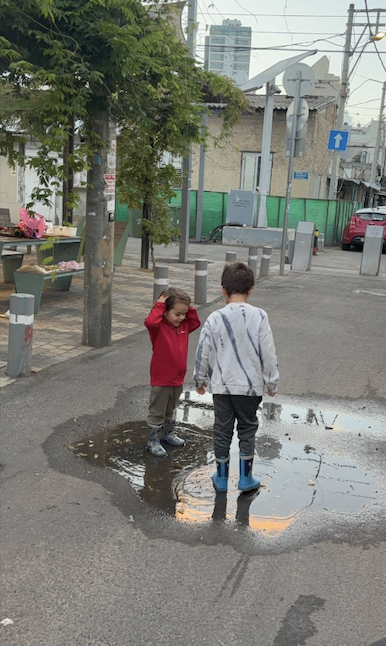
But one thing they can figure out without any guidance is the weather. My son, Idan woke up on Nov 20th this year and opened the door to check the weather and immediately screamed, "It's freezing." He continued - "Winter is here." It was 65 degrees Fahrenheit in Tel Aviv, but let's put that aside. The sun was hidden behind the clouds, it had cooled down enough for a light sweatshirt, and most importantly, a little rain had fallen meaning—there were puddles. After a lazy rainy Saturday morning, we got ready to go out and down to the beach.
The kid's plans were clear: FIND ALL PUDDLES. JUMP IN PUDDLES. SPLASH AND GIGGLE.
This moment captures something profound that Dr. Peter Gray's research on play reveals: one of play's primary functions is helping children feel in control when so much of their world is controlled by adults. As Gray notes, "For most children, the only time when they are in control of their world is when they are playing."
There were big puddles and little puddles. Deep ones and some that were barely even puddles, but they found every one on our path and even a few off our path. They didn't care at all about making it to the beach that day; they were having a blast on the way.
Generally, I feel like our kids teach us things—things that are more important than what we are learning elsewhere—things about what actually matters. Dr. Stuart Brown, founder of the National Institute for Play, discovered through decades of research that play is "as basic a natural phenomenon as sleep, and, like sleep, many of us aren't getting enough of it."
I've learned that you can minimize the play or bask in the play (in life and also with your kids). This specific day, I had my rainboots on, and I got to bask in the puddles and in the joy. Research from the University of Otago published in the Journal of Positive Psychology found that engaging in even one playful or creative activity per day creates an "upward spiral for well-being and creativity." Those researchers discovered that people who spent time on creative, playful goals during the day experienced higher positive emotions -- more joy, happiness, and optimism.
What's even more remarkable is what German psychologist René Proyer discovered in his groundbreaking research: playful adults don't just feel better in the moment -- they experience higher life satisfaction overall, engage in more enjoyable activities, lead more active lifestyles, and even show better physical fitness. His studies revealed that adult playfulness has robust positive relationships with all these markers of wellbeing.
Playfulness isn't just something children have, and adults lose -- it's actually something we can cultivate. Proyer's intervention studies have proven this definitively: playfulness can be trained through awareness of its benefits and deliberate practice. When adults intentionally engaged in playful activities for just one week, they showed increased wellbeing and reduced depression symptoms that lasted for months.
This means that every time we choose to play—like puddle-jumping with our kids (or without kids)—we're not just having a momentary experience but potentially reshaping our personality in ways that enhance our overall wellbeing. Studies have demonstrated that by intentionally engaging in playful activities, we can nurture and strengthen this trait, leading to a happier and more adaptable life.